






Someone Let Me Down and I Don't Know Whether It Was a Mistake or a Pattern — How to Assess a One-Time Slip, Repeated Behavior, and Genuine Willingness to Make Amends Without Making a Decision Based on a Single Night Max Paradox
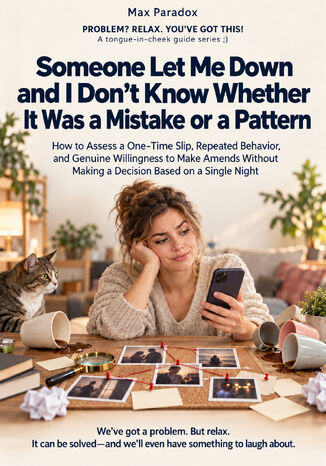
- Autor:
- Max Paradox
- Wydawnictwo:
- self publisher
- Ocena:
- Stron:
- 241
- Dostępne formaty:
-
PDFePub
-
 Publikacja stworzona ze wsparciem AI
Opis
książki
:
Someone Let Me Down and I Don't Know Whether It Was a Mistake or a Pattern — How to Assess a One-Time Slip, Repeated Behavior, and Genuine Willingness to Make Amends Without Making a Decision Based on a Single Night
Someone disappoints you. They apologize. You want to believe them. But somewhere in the back of your mind, a tiny detective has opened a case file, collected twelve screenshots, and started questioning witnesses who weren't even there.
Was it an honest mistake? A misunderstanding? A sign of something that keeps happening? Or are you about to make a life-changing decision because your emotions held an emergency meeting at two in the morning?
Someone Let Me Down and I Don't Know Whether It Was a Mistake or a Pattern is a practical, funny, and refreshingly realistic guide to understanding disappointment, evaluating trust, and deciding what to do when someone important lets you down.
With sharp observational humor and relatable examples, Max Paradox explores the uncomfortable territory between forgiving everything and treating every mistake as proof that someone has revealed their true character.
Through twenty engaging chapters, you'll learn to distinguish what actually happened from the explanations your imagination supplies. You'll discover how to recognize repeated behavior even when every incident looks different, why understanding somebody's difficulties doesn't require accepting unlimited consequences, and how to have difficult conversations without turning one disagreement into a complete historical investigation of the relationship.
The book also examines what genuine repair looks like. Is an apology enough? How can you recognize meaningful change rather than a temporary burst of excellent behavior? What makes a second chance reasonable, and when does another opportunity simply expose you to the same disappointment again?
You'll explore practical ways to establish boundaries, create realistic agreements, and adjust trust according to the responsibilities involved. You'll also discover why the people who care about you don't need to agree unanimously about your decisions and why you can sometimes leave a relationship without proving that the other person is a villain.
Importantly, this isn't a guide that assumes everyone can simply walk away from difficult people. Colleagues, relatives, shared responsibilities, financial constraints, and complicated personal histories can make distance difficult or impossible. The book considers how to cooperate when trust is limited, how to respond when an old problem returns, and how to recognize genuine improvement without spending the rest of your life monitoring it.
Most importantly, it acknowledges something reassuring: you don't need perfect certainty about another person's motives to make a reasonable decision about your own life.
This book won't promise to turn everyone around you into dependable, emotionally sophisticated adults. That would require technology considerably more advanced than anything currently available.
Instead, it offers clearer thinking, useful questions, practical decisions, and enough humor to make a difficult subject feel a little more manageable.
Because sometimes someone makes a mistake. Sometimes the same problem keeps returning in increasingly creative disguises. And sometimes the smartest thing you can do is stop trying to deliver a final verdict on another person's character and decide what you're willing to accept.
Your feelings matter. The facts matter. What happens next matters.
And none of those questions necessarily needs to be settled before breakfast.
This publication was prepared using tools that support the creative process, including artificial intelligence solutions. The final concept, structure and editing are the responsibility of the author.




Szczegóły książki
- ISBN Ebooka:
- 978-83-848-3792-4, 9788384837924
- Data wydania ebooka :
-
2026-11-04
 Data wydania ebooka często jest dniem wprowadzenia tytułu do sprzedaży i może nie być równoznaczna
z datą wydania książki papierowej. Dodatkowe informacje możesz znaleźć w darmowym fragmencie.
Jeśli masz wątpliwości skontaktuj się z nami sklep@ebookpoint.pl.
- Język publikacji:
- angielski
- Rozmiar pliku Pdf:
- 1.7MB
- Rozmiar pliku ePub:
- 3.1MB
- Pobierz przykładowy rozdział PDF »
- Pobierz przykładowy rozdział EPUB »

Dzięki opcji "Druk na żądanie" do sprzedaży wracają tytuły Grupy Helion, które cieszyły sie dużym zainteresowaniem, a których nakład został wyprzedany.
Dla naszych Czytelników wydrukowaliśmy dodatkową pulę egzemplarzy w technice druku cyfrowego.
Co powinieneś wiedzieć o usłudze "Druk na żądanie":
- usługa obejmuje tylko widoczną poniżej listę tytułów, którą na bieżąco aktualizujemy;
- cena książki może być wyższa od początkowej ceny detalicznej, co jest spowodowane kosztami druku cyfrowego (wyższymi niż koszty tradycyjnego druku offsetowego). Obowiązująca cena jest zawsze podawana na stronie WWW książki;
- zawartość książki wraz z dodatkami (płyta CD, DVD) odpowiada jej pierwotnemu wydaniu i jest w pełni komplementarna;
- usługa nie obejmuje książek w kolorze.
Masz pytanie o konkretny tytuł? Napisz do nas: sklep@ebookpoint.pl
Książka drukowana


Oceny i opinie klientów: Someone Let Me Down and I Don't Know Whether It Was a Mistake or a Pattern — How to Assess a One-Time Slip, Repeated Behavior, and Genuine Willingness to Make Amends Without Making a Decision Based on a Single Night Max Paradox
(0)