






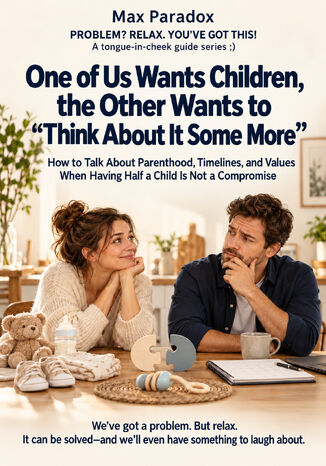
One of Us Wants Children, the Other Wants to “Think About It Some More” — How to Talk About Parenthood, Timelines, and Values When Having Half a Child Is Not a Compromise Max Paradox
- Autor:
- Max Paradox
- Wydawnictwo:
- SELF-PUBLISHER
- Ocena:
- Stron:
- 202
- Dostępne formaty:
-
PDFePub
-
 Publikacja stworzona ze wsparciem AI
Opis
książki
:
One of Us Wants Children, the Other Wants to “Think About It Some More” — How to Talk About Parenthood, Timelines, and Values When Having Half a Child Is Not a Compromise
One wants a baby. The other wants more time. And somehow, "more time" has become a permanent resident of your relationship.
You've talked about having children. You've discussed money, careers, housing, responsibilities, and whether either of you is truly ready. You've probably had the same conversation so many times that you could perform both sides of it without your partner being present.
Yet the question remains: What happens when two people love each other but may want fundamentally different futures?
In One of Us Wants Children, the Other Wants to "Think About It Some More", Max Paradox explores one of the most emotionally complicated disagreements a couple can face.
With sharp observational humor, empathy, and practical insight, this book helps you understand what is really happening beneath the endless discussions about babies, timing, and commitment.
Is your partner genuinely uncertain, frightened of responsibility, waiting for better circumstances, or avoiding an answer they suspect you won't want to hear? Are you expressing an important personal desire or slowly turning your relationship into an international negotiation over reproductive policy?
And most importantly, how do you find clarity without pressuring someone into a life they don't want?
Through relatable situations, thoughtful explanations, and realistic approaches to difficult conversations, you'll explore how to:
Distinguish genuine uncertainty from avoidance and a considered refusal.
Discuss parenthood, timing, and practical responsibilities without turning every conversation into an argument.
Understand how childhood experiences, personal values, and fears shape reproductive choices.
Recognize emotional pressure and protect voluntary consent and bodily autonomy.
Examine money, careers, caregiving, and the often-invisible workload of raising children.
Consider parenting together, remaining child-free, or separating without treating either partner as the villain.
Navigate family expectations, difficult circumstances, and the emotions that remain after an important decision.
The book doesn't assume everyone should become a parent. It doesn't suggest that choosing a child-free life is selfish, that wanting motherhood or fatherhood is automatically more meaningful, or that every loving relationship must survive fundamental incompatibility.
Instead, it recognizes something many couples desperately need to hear: understanding each other doesn't always mean wanting the same thing.
Sometimes a couple discovers that practical concerns can be addressed. Sometimes they reach a shared decision after careful reflection. And sometimes they realize that their love is genuine but their future plans cannot honestly be combined.
Max Paradox approaches these possibilities without judgment, false promises, or the exhausting insistence that every difficult problem can be solved through positive thinking.
This is a thoughtful, funny, and compassionate guide for couples navigating different desires about children, people struggling with indecision, and anyone trying to make an important relationship choice without losing respect for themselves or their partner.
Because compromise is useful when choosing a restaurant, a holiday destination, or a sofa.
But having half a child remains a remarkably impractical arrangement.
This publication was prepared using tools that support the creative process, including artificial intelligence solutions. The final concept, structure and editing are the responsibility of the author.




Szczegóły książki
- ISBN Ebooka:
- 978-83-848-3664-4, 9788384836644
- Data wydania ebooka :
-
2026-11-04
 Data wydania ebooka często jest dniem wprowadzenia tytułu do sprzedaży i może nie być równoznaczna
z datą wydania książki papierowej. Dodatkowe informacje możesz znaleźć w darmowym fragmencie.
Jeśli masz wątpliwości skontaktuj się z nami sklep@ebookpoint.pl.
- Język publikacji:
- angielski
- Rozmiar pliku Pdf:
- 1.5MB
- Rozmiar pliku ePub:
- 2.9MB
- Pobierz przykładowy rozdział PDF »
- Pobierz przykładowy rozdział EPUB »

Dzięki opcji "Druk na żądanie" do sprzedaży wracają tytuły Grupy Helion, które cieszyły sie dużym zainteresowaniem, a których nakład został wyprzedany.
Dla naszych Czytelników wydrukowaliśmy dodatkową pulę egzemplarzy w technice druku cyfrowego.
Co powinieneś wiedzieć o usłudze "Druk na żądanie":
- usługa obejmuje tylko widoczną poniżej listę tytułów, którą na bieżąco aktualizujemy;
- cena książki może być wyższa od początkowej ceny detalicznej, co jest spowodowane kosztami druku cyfrowego (wyższymi niż koszty tradycyjnego druku offsetowego). Obowiązująca cena jest zawsze podawana na stronie WWW książki;
- zawartość książki wraz z dodatkami (płyta CD, DVD) odpowiada jej pierwotnemu wydaniu i jest w pełni komplementarna;
- usługa nie obejmuje książek w kolorze.
Masz pytanie o konkretny tytuł? Napisz do nas: sklep@ebookpoint.pl
Książka drukowana


Oceny i opinie klientów: One of Us Wants Children, the Other Wants to “Think About It Some More” — How to Talk About Parenthood, Timelines, and Values When Having Half a Child Is Not a Compromise Max Paradox
(0)