






My Child Has a Friend Who Is a Bot — How to Talk About Chatbot Relationships, Privacy, and Emotions, and Help Your Child Distinguish an Easy Conversation from a Real Bond Max Paradox

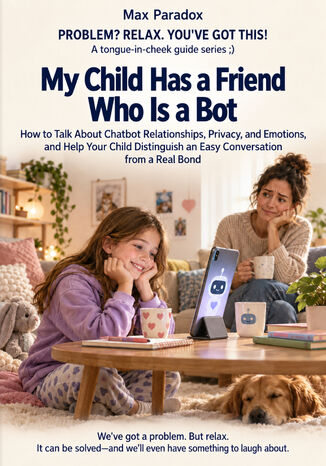
- Autor:
- Max Paradox
- Wydawnictwo:
- SELF-PUBLISHER
- Ocena:
- Stron:
- 208
- Dostępne formaty:
-
PDFePub
-
 Publikacja stworzona ze wsparciem AI
Opis
książki
:
My Child Has a Friend Who Is a Bot — How to Talk About Chatbot Relationships, Privacy, and Emotions, and Help Your Child Distinguish an Easy Conversation from a Real Bond
Your child has a new best friend. It replies instantly, never gets tired, always has something to say, and occasionally announces that it misses them. There's just one small detail: this friend is a chatbot.
Welcome to modern parenting, where discussing friendships may involve checking an application's privacy settings, and asking who your child is talking to can produce the answer, "You wouldn't understand. He's an AI."
Should you worry? Ban the application? Read every conversation? Or politely ask whether the digital companion would like to join the family for dinner?
In My Child Has a Friend Who Is a Bot, Max Paradox explores one of the strangest and most important questions facing families: what happens when children begin forming emotional attachments to artificial intelligence?
With intelligent humor, practical examples, and a refreshingly calm approach, this guide helps parents understand why AI companions can feel so appealing. They may offer endless patience, personalized conversations, apparent understanding, and reassuring responses without the ordinary complications of human relationships. But convenience and genuine friendship are not the same thing.
The book explains how to recognize that difference without dismissing children's feelings or treating every chatbot conversation as a developing emergency.
You'll discover how to talk about AI relationships without turning ordinary curiosity into an interrogation. You'll learn why children sometimes confide in chatbots instead of parents, how generated affection can create feelings of obligation, and why an AI companion that always agrees may gradually influence expectations about real friendships.
The guide also tackles practical concerns that families cannot afford to ignore: protecting personal information, evaluating AI companion applications, understanding persuasive messages, identifying unreliable advice, and responding when a chatbot says something disturbing or inappropriate.
Rather than recommending automatic bans or constant surveillance, Max Paradox shows how to establish realistic boundaries that respect children's growing independence while maintaining appropriate protection.
The book explores situations that rarely fit into simple rules. What if a child feels genuinely upset when an AI character disappears after an update? What if a chatbot helps a lonely child communicate or organize difficult thoughts? What if someone online uses an artificial identity to gain trust? And how can parents tell whether an AI companion is supporting their child's life or increasingly replacing experiences they want to have with other people?
You'll also find ways to use conversational AI constructively, from rehearsing difficult conversations to developing creative projects that bring children together with real people.
Throughout its twenty chapters, the book keeps one distinction at the center: a child's feelings about an AI companion can be genuine, even when the companion's apparent affection is generated by software.
Understanding that distinction doesn't require a degree in computer science, unlimited parental patience, or the ability to recognize every new application before your teenager discovers it.
It requires curiosity, sensible safeguards, honest conversations, and enough perspective to avoid turning the family home into an emergency command center for suspiciously friendly robots.
Written for parents and caregivers of children and teenagers, this practical, humorous guide offers a way to approach AI companionship without panic, ridicule, or technological denial.
Because the goal isn't to raise children who never talk to chatbots. It's to help them understand the difference between an easy conversation and a genuine human bond, so they can enjoy useful technology without letting it make their most important decisions.
The bot can stay. It just doesn't get to run the family.
This publication was prepared using tools that support the creative process, including artificial intelligence solutions. The final concept, structure and editing are the responsibility of the author.




Szczegóły książki
- ISBN Ebooka:
- 978-83-848-3582-1, 9788384835821
- Data wydania ebooka :
-
2026-10-16
 Data wydania ebooka często jest dniem wprowadzenia tytułu do sprzedaży i może nie być równoznaczna
z datą wydania książki papierowej. Dodatkowe informacje możesz znaleźć w darmowym fragmencie.
Jeśli masz wątpliwości skontaktuj się z nami sklep@ebookpoint.pl.
Data wydania ebooka często jest dniem wprowadzenia tytułu do sprzedaży i może nie być równoznaczna
z datą wydania książki papierowej. Dodatkowe informacje możesz znaleźć w darmowym fragmencie.
Jeśli masz wątpliwości skontaktuj się z nami sklep@ebookpoint.pl.
- Język publikacji:
- angielski
- Rozmiar pliku Pdf:
- 1.5MB
- Rozmiar pliku ePub:
- 2.1MB
- Pobierz przykładowy rozdział PDF »
- Pobierz przykładowy rozdział EPUB »

Dzięki opcji "Druk na żądanie" do sprzedaży wracają tytuły Grupy Helion, które cieszyły sie dużym zainteresowaniem, a których nakład został wyprzedany.
Dla naszych Czytelników wydrukowaliśmy dodatkową pulę egzemplarzy w technice druku cyfrowego.
Co powinieneś wiedzieć o usłudze "Druk na żądanie":
- usługa obejmuje tylko widoczną poniżej listę tytułów, którą na bieżąco aktualizujemy;
- cena książki może być wyższa od początkowej ceny detalicznej, co jest spowodowane kosztami druku cyfrowego (wyższymi niż koszty tradycyjnego druku offsetowego). Obowiązująca cena jest zawsze podawana na stronie WWW książki;
- zawartość książki wraz z dodatkami (płyta CD, DVD) odpowiada jej pierwotnemu wydaniu i jest w pełni komplementarna;
- usługa nie obejmuje książek w kolorze.
Masz pytanie o konkretny tytuł? Napisz do nas: sklep@ebookpoint.pl
Książka drukowana


Oceny i opinie klientów: My Child Has a Friend Who Is a Bot — How to Talk About Chatbot Relationships, Privacy, and Emotions, and Help Your Child Distinguish an Easy Conversation from a Real Bond Max Paradox
(0)